Mumbai’s iconic skyline has long benefited from a natural advantage—the Arabian Sea. Coastal winds acting as a shield have traditionally helped the financial capital sweep away toxic smog, saving it from the severe air quality crises faced by northern cities like Delhi.
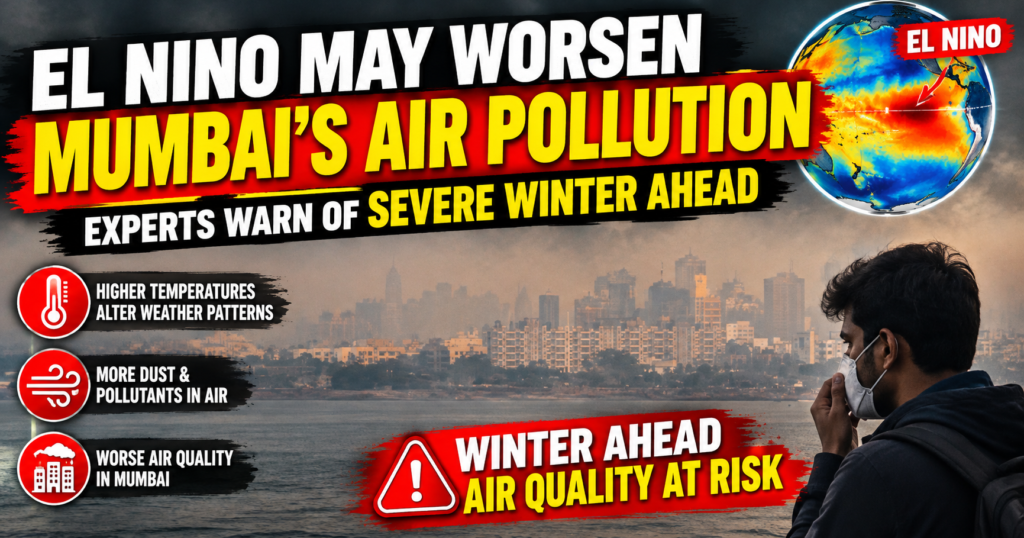
However, experts are now sounding the alarm. Meteorological conditions driven by El Nino are expected to drastically alter wind patterns this winter, making Mumbai’s air pollution crisis significantly worse.
Why Mumbai’s Air Quality is Deteriorating
In recent weeks, Mumbai’s Air Quality Index (AQI) has slipped deep into the “poor” and “very poor” categories, sometimes crossing alarming thresholds. While local factors like massive construction dust, vehicular emissions, and industrial operations are constant contributors, scientists point out that external climate drivers are multiplying the risk this season.
According to leading atmospheric scientists, including Dr. Gufran Beig (Chair Professor at NIAS, IISc campus), the emergence of a strong Super El Nino phase is altering large-scale wind movements globally and locally.
Key Factors Driving the Pollution Spike:
- Sluggish Wind Speeds: El Nino conditions slow down general wind circulation. Instead of strong, clear sea breezes sweeping pollutants away, sluggish winds trap dust and particulate matter ($\text{PM}_{2.5}$ and $\text{PM}_{10}$) right over the city.
- Loss of Natural Coastal Shield: Because the wind velocity drops significantly, Mumbai’s geographical positioning near the sea loses its effectiveness as a natural air scrubber.
- Humidity and Salt Particles: High humidity combined with sluggish winds and marine salt particles ($\text{NaCl}$) creates a dense haze and smog layer that lingers over urban neighborhoods for longer periods.
- Regional Pollutant Transport: Coupled with lower-than-normal seasonal rainfall, dry winds and external factors like agricultural stubble burning or regional dust influx are compounding the crisis.
What Experts Say About the Coming Months
Environmental experts warn that if wind speeds remain low through the peak winter months, Mumbai could experience unprecedented stagnation conditions.
“When wind speed is low, local pollutants have nowhere to go. They get trapped in the lower atmosphere, creating a thick blanket of smog over the city,” notes an expert tracking regional climate shifts.
This shift has put civic bodies and administrative authorities under intense judicial and public scrutiny. High courts and citizens’ groups have raised concerns over the strict implementation of dust-mitigation norms, garbage burning controls, and real-time monitoring of pollution hotspots.
Health Impacts: Protecting Yourself from Toxic Air
With fine particulate matter ($\text{PM}_{2.5}$) penetrating deep into the lungs, citizens—especially children, the elderly, and those with pre-existing respiratory or cardiovascular conditions—are advised to take precautions:
- Check Daily AQI: Monitor local air quality indexes before planning outdoor morning workouts.
- Wear Masks: Use N95 masks if stepping out into heavily polluted or high-traffic zones.
- Use Air Purifiers: Keep indoor spaces filtered where possible and minimize ventilation during peak smog hours.
Conclusion
Geography alone can no longer guarantee clean air for Mumbai. As climate patterns like El Nino reshape regional weather dynamics, tackling local emissions with strict, accountable measures is more critical than ever. Unless rigorous dust-suppression and emission-control strategies are enforced uniformly, Mumbaikars are staring at a toxic and challenging winter ahead.