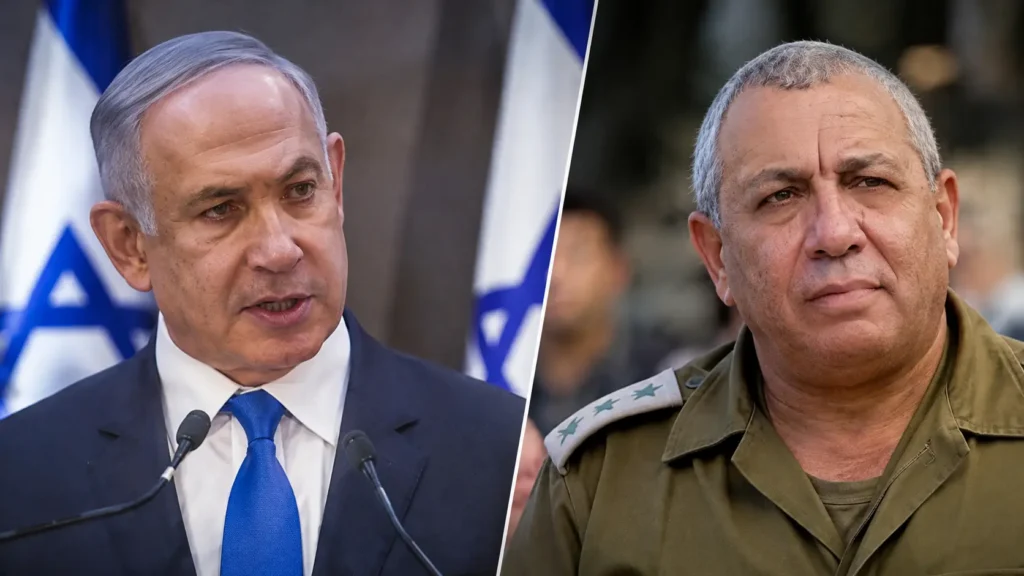
Israel Election 2026: Israeli Prime Minister Benjamin Netanyahu is facing a major political challenge after two Arab-majority political groups announced their support for opposition leader Gadi Eisenkot to form the country’s next government. The development follows Israel’s October 27 parliamentary election, which failed to deliver a clear majority to either political camp.
Eisenkot, a former Israeli military chief and leader of the Yashar party, has received recommendations from 67 members of the 120-seat Knesset. Netanyahu has secured recommendations from 46 lawmakers, while seven have declined to endorse either candidate.
Despite Eisenkot’s numerical advantage, forming a stable coalition remains difficult because some of his potential political allies oppose relying on Arab parties for parliamentary support.
Israel Election 2026: Gadi Eisenkot Receives Support From 67 Lawmakers
Israel’s political landscape has entered a crucial phase following the inconclusive parliamentary election.
During consultations conducted by President Isaac Herzog, 67 lawmakers recommended Eisenkot as the candidate to form the next government.
Netanyahu, who has dominated Israeli politics for years, received 46 recommendations.
However, recommendations are not the same as a formal parliamentary majority supporting a government.
Eisenkot must still negotiate an agreement that can command the confidence of at least 61 members of parliament.
President Herzog is expected to announce on Sunday, November 8, which candidate will receive the first opportunity to form a government.
Two Arab Parties Could Decide Israel’s Next Prime Minister
The Joint List and Ra’am, also known as the United Arab List, have emerged as influential players in Israel’s government formation process.
Together, the two Arab-majority groups secured 19 seats in the October 27 election.
The Joint List won 11 seats, while Ra’am secured eight.
Both groups have recommended Gadi Eisenkot to President Herzog.
Their support has strengthened Eisenkot’s position considerably and could help him challenge Netanyahu’s leadership.
However, the decision has also exposed divisions within the broader opposition.
Why Is Eisenkot Facing Problems Despite Majority Recommendations?
Although Eisenkot has the backing of 67 lawmakers during presidential consultations, several political disagreements remain unresolved.
Avigdor Liberman, the leader of the right-wing Israel Beiteinu party, has repeatedly opposed joining a government dependent on Arab-majority political parties.
One major dispute concerns how Arab political leaders describe Hamas.
Liberman has criticised Arab parties for declining to explicitly designate Hamas as a terrorist organisation, despite their condemnation of the October 7, 2023 attacks on Israel.
Eisenkot has also faced difficulties reconciling the positions of potential coalition partners.
These disagreements could prevent him from translating his numerical advantage into a functioning government.
Benjamin Netanyahu’s Political Position Weakens
Netanyahu’s political alliance secured 53 seats in the newly elected Knesset, falling short of the 61 required for a majority.
His Likud party remained the largest individual party, winning 27 seats.
However, the prime minister suffered another setback when United Torah Judaism, a long-standing ultra-Orthodox political ally, declined to recommend him for another term.
The party also refused to endorse Eisenkot.
United Torah Judaism holds seven seats and has previously played an important role in Netanyahu-led governments.
Its decision highlights growing tensions within Israel’s religious and right-wing political alliances.
Nevertheless, Netanyahu remains a significant contender because Eisenkot’s potential coalition faces serious internal divisions.
Military Service Exemptions Become a Major Political Issue
One of the most important disputes in Israeli politics concerns military service exemptions for ultra-Orthodox religious students.
United Torah Judaism and Shas have supported maintaining exemptions for students studying in religious institutions.
The issue has become increasingly controversial amid Israel’s prolonged military conflicts and the burden placed on reservists.
Netanyahu has maintained the existing exemption arrangements but has not permanently secured them through legislation.
Eisenkot, meanwhile, has taken a stronger position in favour of ending such exemptions.
The disagreement could play an important role in determining which political alliance can successfully form the next government.
Who Is Gadi Eisenkot?
Gadi Eisenkot is a former chief of staff of the Israel Defense Forces and a prominent opposition politician.
He leads the Yashar party and has presented himself as an alternative to Netanyahu’s leadership.
During the election campaign, Eisenkot emphasised national unity and the need to rebuild public confidence in Israel’s political institutions.
His military background and opposition to Netanyahu have helped him attract support from different sections of Israeli society.
However, his ability to become prime minister depends on whether he can bring together parties with sharply different political positions.
What Did Israeli President Isaac Herzog Say?
President Isaac Herzog has acknowledged that the government formation process is complicated.
Although Eisenkot has received more recommendations, Herzog must determine which candidate has the best chance of establishing a viable government.
The president has indicated that political disagreements and mutual objections between parties make the outcome uncertain.
He is expected to hold further discussions with political leaders before announcing his decision on Sunday.
The president’s choice will mark the beginning of formal coalition negotiations.
What Happens If Eisenkot Fails to Form a Government?
Under Israel’s parliamentary system, the candidate selected by the president generally receives 28 days to form a government.
An additional extension of up to 14 days may be granted.
If the selected candidate cannot secure sufficient parliamentary support, the president may offer another lawmaker an opportunity to form a government.
This means Eisenkot’s higher number of recommendations does not automatically guarantee that he will become prime minister.
Netanyahu could still have an opportunity if opposition negotiations fail.
Until a new government is sworn in, Netanyahu continues to serve as caretaker prime minister.
Israel Election 2026: Key Political Numbers
| Political development | Details |
|---|---|
| Parliamentary election | October 27, 2026 |
| Total Knesset seats | 120 |
| Seats required for majority | 61 |
| Recommendations for Eisenkot | 67 |
| Recommendations for Netanyahu | 46 |
| Lawmakers who abstained | 7 |
| Netanyahu-aligned bloc | 53 seats |
| Eisenkot’s core opposition bloc | 48 seats |
| Arab-majority parties | 19 seats |
| Presidential decision expected | November 8, 2026 |
Could Arab Parties Become Kingmakers in Israel?
The strong performance of Arab-majority political parties has made them potentially decisive in Israel’s post-election negotiations.
Their combined 19 seats could provide the parliamentary support needed to replace Netanyahu.
However, opposition from right-wing parties creates a difficult political equation.
Eisenkot may need to negotiate an arrangement that satisfies both Arab-majority lawmakers and other opposition partners.
Whether such an agreement is possible remains uncertain.
Conclusion
The Israel Election 2026 has created a major political challenge for Benjamin Netanyahu, with opposition leader Gadi Eisenkot receiving recommendations from 67 lawmakers.
Support from two Arab-majority political groups has strengthened Eisenkot’s prospects, while United Torah Judaism’s decision not to endorse Netanyahu has complicated the incumbent prime minister’s position.
However, disagreements over Arab-party participation and military service exemptions could prevent Eisenkot from forming a stable coalition.
President Isaac Herzog’s expected announcement on November 8 will be the next important step in determining Israel’s political future.