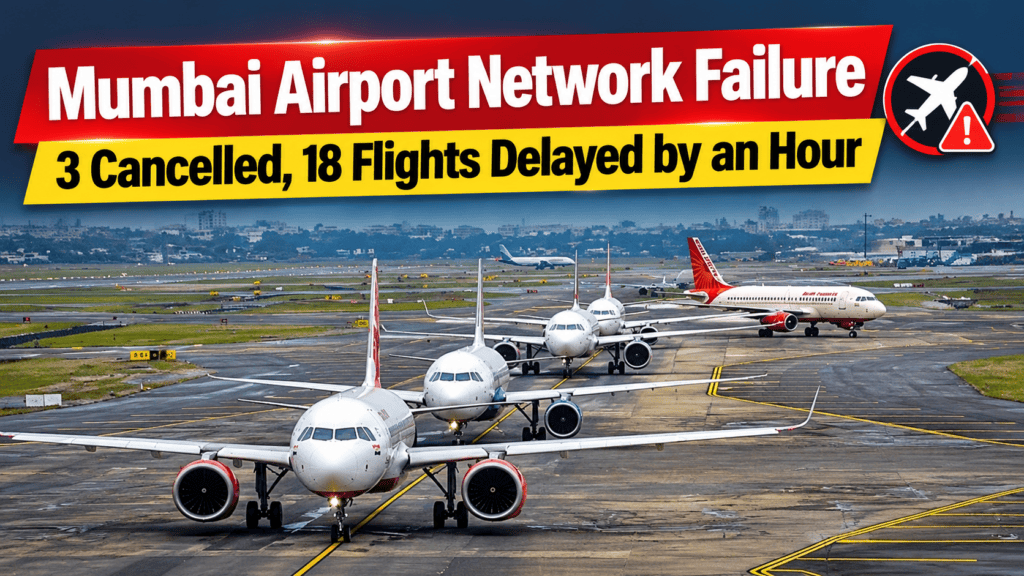
Mumbai airport faced a network failure on Tuesday evening, October 27, 2026, disrupting passenger check-in and boarding procedures at Chhatrapati Shivaji Maharaj International Airport (CSMIA). The technical issue affected passengers travelling with Air India and IndiGo, forcing airport staff to switch to manual processing to maintain essential services.
According to a report published by Hindustan Times, the network disruption affected check-in procedures for approximately 11 Air India flights and three IndiGo flights. The problem reportedly began at around 7:05 pm and initially lasted approximately 50 minutes, although the system continued to experience fluctuations as technical teams worked to restore normal operations.
The Hindustan Times headline reported that 18 flights were delayed by an hour or more and three were cancelled. However, the available information does not establish that every delay or cancellation was directly caused by the network failure.
The incident highlighted the importance of reliable airport technology and effective backup arrangements at one of India’s busiest aviation hubs.
Mumbai Airport Network Glitch Disrupts Check-In Operations
The network failure affected passenger check-in and boarding-related procedures at Mumbai airport, creating difficulties for travellers during the evening departure period.
Modern airports depend on interconnected digital systems to process passengers, verify boarding passes and coordinate departures. When these systems experience technical difficulties, airport personnel may need to rely on manual procedures to maintain essential services.
According to Hindustan Times, approximately 11 Air India flights and three IndiGo flights experienced check-in-related problems during the disruption.
Although passenger processing slowed, the available reports indicated that check-in operations did not come to a complete halt. Airport teams implemented alternative procedures while efforts continued to restore normal system functionality.
The disruption reportedly began at approximately 7:05 pm on October 27. The initial problem lasted around 50 minutes, although fluctuations continued to affect the system.
Passengers experienced slower processing at departure areas, while reports of gate changes and crew-related delays added to the confusion.
18 Flights Delayed by an Hour or More, Three Cancelled
The incident attracted attention because of reports highlighting significant flight delays and cancellations at Mumbai airport.
The Hindustan Times headline reported that 18 flights were delayed by an hour or more and three were cancelled. These figures indicate the difficulties faced by passengers, although the precise number of flights delayed exclusively because of the network failure remains unclear.
A separate report by The Economic Times, citing flight-tracking data, reported that 327 flights had been delayed by approximately 9:30 pm, with average departure delays of around 50 minutes.
That report also highlighted cancellations across airport operations. However, these broader figures should not be interpreted as a count of flights cancelled directly because of the network disruption.
Air traffic control congestion had also contributed to operational delays, according to the available reporting. The network failure added another challenge for airlines and airport staff.
Passengers should therefore distinguish between delays directly associated with the network problem and the broader delays recorded across the airport during the same period.
Air India and IndiGo Passengers Among Those Affected
Air India and IndiGo were among the airlines affected by the network disruption, according to the Hindustan Times report.
The reported impact included check-in difficulties involving approximately 11 Air India flights and three IndiGo flights.
When passenger-processing systems become unreliable, travellers may have to wait longer to complete check-in, baggage drop and boarding formalities. Even a temporary interruption can create confusion at busy departure terminals.
Reports also mentioned boarding scanner issues and gate changes during the disruption.
Passengers travelling on connecting flights may face additional uncertainty when departure times change, particularly when their onward journeys have tight connection windows.
However, the available reports do not establish that every flight operated by Air India or IndiGo was affected.
Travellers should check their individual flight status through their airline’s official website or mobile application rather than assuming that all departures have been delayed or cancelled.
Airport Switches to Manual Processing
Following the network disruption, airport staff switched to manual processing measures to maintain essential passenger services.
Manual processing allows personnel to continue certain airport procedures when automated systems are unavailable or unreliable. Depending on the systems affected, these procedures can require additional time and staff involvement.
At a busy airport such as Mumbai, slower processing can lead to longer queues and additional pressure on ground staff.
The airport operator, Chhatrapati Shivaji Maharaj International Airport, acknowledged the temporary network disruption and said measures had been implemented to minimise inconvenience.
The operator also stated that airport and flight operations had not been affected by the network issue.
This statement should be considered alongside reports of delays and cancellations during the same period. A temporary passenger-processing disruption and broader flight delays are different operational measures, and the available reporting does not establish that every delayed flight was affected by the same cause.
What Caused the Mumbai Airport Network Failure?
The available reports described a network disruption but did not establish a definitive technical cause.
It would therefore be premature to attribute the incident to a cyberattack, a particular software provider or a hardware failure without confirmation from the airport operator or other relevant authorities.
Airport systems depend on technology to coordinate check-in, boarding and other passenger-facing procedures. A problem affecting network connectivity can interfere with these processes even when other airport functions continue.
The incident demonstrates why airports need effective backup procedures and clear communication arrangements.
Manual processing can help maintain essential services during technical difficulties, but its effectiveness depends on the nature of the problem and the procedures available to airport staff.
Further information from the airport operator would be needed to establish the precise cause of the disruption.
Air Traffic Control Congestion Added to Operational Challenges
The network failure occurred amid wider operational challenges at Mumbai airport.
According to the available reporting, airlines were already experiencing delays associated with air traffic control congestion. The network disruption added to the difficulties faced by passengers and airport personnel.
Air traffic control congestion and airport network failures are separate issues, although both can contribute to delays.
Flights may be delayed because of air traffic management, weather conditions, aircraft availability, crew scheduling or technical problems. A network disruption affecting passenger processing can introduce further complications without necessarily being the sole reason for a delayed departure.
The broader flight-tracking figures reported during the incident therefore need to be interpreted carefully.
For passengers, the most useful information is the current status of their particular flight, including any revised departure time or boarding gate.
What Should Passengers Travelling From Mumbai Airport Do?
Passengers scheduled to depart from Mumbai airport should check their flight status directly with their airline before leaving for the airport.
Travellers should allow sufficient time for check-in, baggage drop, security screening and boarding. During a technical disruption, manual processing may take longer than usual.
Passengers already at the airport should monitor information screens and listen to announcements from airport and airline staff.
If a boarding gate changes, travellers should confirm the updated gate number instead of relying only on an earlier boarding pass or announcement.
Those with connecting flights should contact their airline if a delay threatens their connection. Passengers should confirm available options directly with the airline rather than assuming their tickets will automatically be changed.
Keeping booking details and identification documents readily available can also help passengers complete airport formalities more efficiently.
Travellers should avoid assuming that every flight has been cancelled because of a temporary network problem. The impact may vary depending on the airline, flight schedule and systems affected.
Why Airport Network Reliability Matters
Modern airports rely on digital systems to manage passenger processing and coordinate essential services.
Check-in systems support reservation verification and boarding-pass issuance. Boarding scanners help staff confirm passenger details, while other systems support baggage handling and operational coordination.
When network connectivity is disrupted, some of these processes may slow down or require alternative arrangements.
Manual processing provides a contingency option, but it can take longer than normal automated procedures. This makes reliable technology, tested backup arrangements and effective communication essential for airports handling large passenger volumes.
The Mumbai incident highlights how even a temporary technical problem can inconvenience travellers and place additional pressure on airport staff.
Clear information about check-in arrangements, boarding gates and departure times can help passengers make informed decisions during such disruptions.
Is Mumbai Airport Operating Normally Now?
The available reports described the network disruption on October 27, 2026, as temporary, with the initial problem lasting approximately 50 minutes.
The airport operator stated that airport and flight operations had not been affected by the network issue. However, this statement should not be treated as a real-time confirmation that every airline system is currently operating normally.
Passengers travelling after the reported incident should check their flight status and monitor announcements for any further changes.
For live information, travellers should use their airline’s official website or mobile application and follow instructions provided by airport staff.
Frequently Asked Questions
What happened at Mumbai airport on October 27, 2026?
A temporary network disruption affected check-in and boarding-related procedures, prompting airport staff to switch to manual processing.
How many flights were delayed or cancelled?
The Hindustan Times headline reported 18 flights delayed by an hour or more and three cancellations. The available reporting does not establish that every delay or cancellation was directly caused by the network failure.
Which airlines were affected?
Air India and IndiGo passengers were among those affected by the reported check-in disruption.
Why did the airport switch to manual processing?
Manual processing was introduced to maintain essential passenger services while the technical issue was being addressed.
Has the cause of the network failure been confirmed?
The available reports did not establish a definitive technical cause for the network disruption.
What should passengers do if their flight is delayed?
Passengers should check their airline’s official flight-status updates, follow airport announcements and contact the airline if they need assistance with a delayed departure or connecting flight.
Conclusion
Mumbai airport experienced a temporary network disruption on October 27, 2026, affecting passenger check-in and boarding procedures and creating difficulties for travellers flying with airlines including Air India and IndiGo.
The Hindustan Times headline reported 18 flights delayed by an hour or more and three cancellations, while separate flight-tracking reports indicated wider delays across the airport. The exact number of delays and cancellations directly attributable to the network failure remains unclear.
Airport teams switched to manual processing to maintain essential services while working to restore normal operations.
The incident highlights the importance of reliable airport technology, effective backup procedures and timely communication with passengers. Travellers departing from Mumbai should continue to verify their individual flight status through official airline channels before travelling.
Additional source:
The Economic Times:
https://economictimes.indiatimes.com/industry/transportation/airlines-/-aviation/mumbai-airport-operations-disrupted-due-to-system-outage-327-flights-delayed/articleshow/135241221.cms