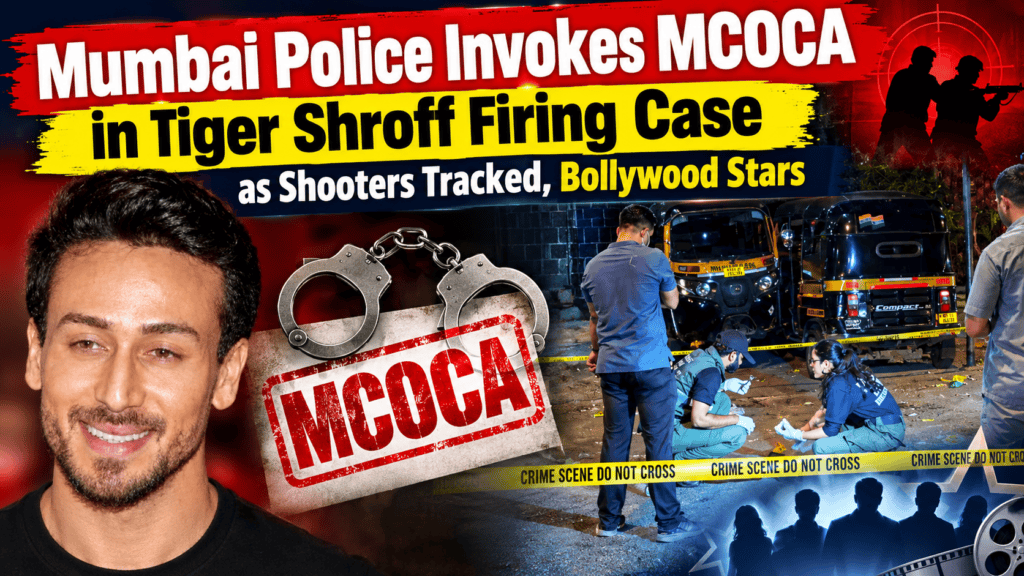
Mumbai Police Invokes has invoked provisions of the Maharashtra Control of Organised Crime Act (MCOCA) in the firing case linked to Bollywood actor Tiger Shroff, marking a significant development in the investigation into the alleged organised crime network behind the incident. Investigators are examining the suspected roles of the shooters, their associates and individuals who may have conducted surveillance on Bollywood celebrities before the attack.
The case has drawn attention because of concerns about the safety of high-profile personalities in Mumbai, the possible involvement of organised criminal networks and allegations that Bollywood stars were being tracked. Police are working to establish the sequence of events, identify everyone connected to the suspected conspiracy and determine whether the firing was part of a wider pattern of threats or criminal activity.
The invocation of MCOCA is an important legal step. However, the precise allegations against each accused, the evidence collected and the final findings of the investigation will have to be established through the legal process.
Mumbai Police Invokes MCOCA in the Firing Case
MCOCA is a special law enacted in Maharashtra to tackle organised crime. It gives investigators additional legal provisions to deal with criminal activity allegedly carried out by organised syndicates. Its use generally depends on whether the statutory requirements are met, including conditions relating to organised crime and the relevant prior criminal cases.
In the Tiger Shroff firing case, the reported decision to invoke MCOCA indicates that investigators are examining whether the incident was connected to a broader organised criminal operation rather than treating it solely as an isolated act of violence.
Police investigations in such cases typically focus on the alleged planning behind an attack, the roles of the people involved, communications between suspects, financial links and any connections with organised criminal groups. Investigators may also examine whether individuals provided logistical support, arranged transport, gathered information or helped the alleged shooters evade detection.
The application of MCOCA does not, by itself, establish the guilt of any accused person. The allegations must be tested through the judicial process, and the prosecution will need to establish the relevant facts and legal requirements.
Shooters Allegedly Tracked Bollywood Celebrities Through Social Media
One of the most significant aspects of the investigation is the allegation that the shooters monitored several Bollywood celebrities before deciding to target Tiger Shroff.
According to officials cited by The Economic Times, the suspects allegedly examined social media videos and reels to gather information about celebrities’ movements, vehicles and security arrangements. Investigators are examining whether publicly available online content helped the alleged attackers identify potential targets and study their daily routines.
Social media platforms frequently contain photographs and videos showing celebrities at gyms, film sets, restaurants, sporting venues and private events. While such posts are often shared for entertainment and fan engagement, investigators believe that, in this case, some publicly available material may have been used to gather information for surveillance.
Police sources reportedly said that the alleged shooters also conducted reconnaissance near celebrities’ residences. Their objective was reportedly to identify the vehicles used by the actors, understand their movements and assess the security arrangements around them.
Investigators are now examining how this alleged surveillance was carried out, what information was shared between the suspects and whether the activity was coordinated by people operating from different locations.
The allegations have renewed concerns about the potential misuse of social media to monitor public figures. However, investigators will need to establish the specific role played by each accused and verify the evidence collected during the investigation.
Salman Khan Was Reportedly Among the Initial Targets
According to reports based on information from investigators, Bollywood superstar Salman Khan was among the celebrities the alleged shooters initially considered targeting.
The Economic Times reported that the suspects allegedly found security outside Khan’s Galaxy Apartments residence in Bandra too tight to carry out their plans. They reportedly explored other possible targets, including two prominent actors who had worked with Khan, but allegedly could not obtain sufficient information about their movements and vehicles.
These details remain part of the police investigation and should be understood as allegations attributed to investigators, rather than findings established by a court.
The reported change in targets is a significant element of the case because it suggests that investigators are examining a possible selection process involving multiple celebrities. Police are seeking to establish how the suspects allegedly chose their targets, what information they possessed and whether instructions came from other members of a suspected criminal network.
The investigation may also help authorities understand whether the alleged surveillance was limited to a single incident or formed part of a broader attempt to intimidate celebrities and create fear.
Why Did the Alleged Shooters Shift Their Focus to Tiger Shroff?
Investigators reportedly believe the alleged shooters shifted their focus to Tiger Shroff after receiving information from Anil Pandit, who has been described in reports as a suspected conspirator linked to the Lawrence Bishnoi gang.
According to The Economic Times, Pandit allegedly informed the shooters that Shroff regularly visited a football practice ground near Pushpa Park in Juhu on Sundays and had comparatively limited security at that location. Investigators believe this information may have influenced the alleged decision to target the actor.
The reported information about Shroff’s routine has become a key part of the investigation. Police are examining whether the suspects used details about the actor’s regular activities to plan the attack and whether other individuals helped them gather or communicate that information.
The case also raises questions about the security risks associated with predictable public routines. Celebrities often attend regular fitness sessions, sporting activities and professional commitments, but information about these activities can potentially be misused when it becomes available to unknown individuals.
Authorities will need to establish the precise sequence of events, including when the alleged surveillance began, how the target was selected and who was responsible for coordinating the operation.
What Happened in the Tiger Shroff Firing Incident?
The firing incident took place in Mumbai’s Juhu area on the evening of October 18, 2026. According to reports, three motorcycle-borne assailants allegedly opened fire at a car linked to Tiger Shroff near the Pushpa Narsee Park area.
The actor escaped without serious injury, while his driver and a bystander were reported to have sustained injuries. The incident prompted a major investigation by Mumbai Police and the Crime Branch.
Police initially registered a case under relevant provisions of the Bharatiya Nyaya Sanhita (BNS) and the Arms Act. Investigators then began tracing the suspected shooters, examining possible accomplices and looking into the alleged supply and movement of weapons.
The investigation expanded as police pursued leads across different locations, including Mumbai, Delhi and Haryana. Officers have also been examining the alleged links between the accused, suspected gang members and individuals believed to have helped arrange logistics for the attack.
The case is no longer being investigated only as a shooting incident. Police are also examining the possibility of a wider conspiracy involving surveillance, the movement of weapons, coordination among suspects and an alleged organised crime network.
Mumbai Police Invokes MCOCA Against All Accused
On October 27, Mumbai Police invoked provisions of the Maharashtra Control of Organised Crime Act, 1999, against all accused in the case after receiving approval from the competent authority.
According to the official statement reported by multiple news organisations, Sections 3(1)(ii), 3(2) and 3(4) of MCOCA have been added to the case. The original case was registered on October 19 under relevant BNS provisions, including those relating to attempted murder and common intention, along with sections of the Arms Act.
MCOCA is a stringent Maharashtra law designed to address organised crime. It provides a legal framework for prosecuting qualifying organised criminal activity when the applicable statutory conditions are satisfied.
Its invocation indicates that police are pursuing the alleged organised-crime angle and investigating whether the attack was connected to a wider criminal operation. The move also allows the investigation to proceed under the additional provisions that have been approved in the case.
However, invoking MCOCA does not automatically prove that every accused person is guilty. The prosecution will have to establish the allegations and satisfy the applicable legal requirements before a court.
The police investigation remains ongoing, and further evidence will be important in determining the roles of the accused and the strength of the alleged links between them.
Alleged Lawrence Bishnoi Gang Connection Under Investigation
The suspected connection to the Lawrence Bishnoi gang is another major aspect of the case.
According to reports citing the Mumbai Crime Branch, investigators believe the attack may have been intended to generate financial gains through extortion, strengthen the gang’s influence and spread fear among the public. Police have alleged that the accused were connected to an organised criminal syndicate. These claims remain allegations under investigation.
Investigators are examining whether the alleged shooters acted independently or received directions and logistical support from other individuals. They are also looking into how the suspects communicated, whether money changed hands and whether the alleged operation involved people based in multiple states.
Establishing these links is essential to understanding whether the attack was part of a wider criminal conspiracy. Police must determine not only who allegedly carried out the firing but also who may have planned, financed, facilitated or coordinated it.
The investigation may involve examining digital communications, financial transactions, travel movements and other evidence that could help establish the relationships between the suspects. The findings will need to be assessed through the legal process.
What Is MCOCA and Why Is It Important?
The Maharashtra Control of Organised Crime Act is intended to address organised criminal activity that meets the law’s specific requirements. It is more stringent than the ordinary legal provisions that may apply to an isolated offence.
In a case involving allegations of a planned attack, suspected gang links and coordination among multiple people, investigators may seek to use MCOCA if the statutory conditions are satisfied.
The law can carry serious consequences for individuals against whom the relevant charges are ultimately established. For this reason, its invocation represents an important development in the prosecution of the case.
At the same time, the legal process requires the allegations against each accused to be examined individually. Arrest, police allegations and the addition of MCOCA provisions are not equivalent to a conviction.
The court proceedings and the evidence presented by investigators will determine how the case progresses.
Bollywood Celebrity Security Concerns Grow
The Tiger Shroff firing case has brought renewed attention to the security challenges faced by Bollywood celebrities in Mumbai.
Actors often have public schedules, attend regular events and share details of their professional lives online. Although most such information is posted for ordinary promotional or personal reasons, the investigation has raised concerns about whether publicly accessible content can be misused to monitor celebrities.
Security experts commonly advise public figures to be cautious about sharing real-time locations, predictable routines and identifiable travel details. Delaying location-based posts, reviewing privacy settings and coordinating security arrangements for regular visits can help reduce exposure to unnecessary risks.
The case also highlights the importance of cooperation between police, private security teams and people responsible for managing celebrities’ public appearances. Suspicious surveillance, threats and unusual activity around residences or regular venues can be reported to authorities for assessment.
However, it would be premature to draw broader conclusions about the security of all Bollywood celebrities based on a single ongoing investigation. The police must first establish the full circumstances of this incident and determine which allegations are supported by evidence.
What Happens Next in the Investigation?
With MCOCA provisions now added, Mumbai Police is expected to continue investigating the alleged conspiracy and the suspected organised-crime connections.
Key questions include how the shooters allegedly obtained information about celebrities, who directed the change in target, how the weapons were arranged and whether additional individuals helped coordinate the attack.
Investigators will also need to establish the alleged roles of the people arrested so far and determine whether any other suspects remain to be traced. The suspected financial motive, including allegations of extortion, is another important area of the probe.
Authorities have not yet established every aspect of the alleged conspiracy in court. The investigation will continue to depend on evidence gathered by the Crime Branch and the legal assessment of that evidence.
For now, the invocation of MCOCA marks a significant escalation in the Tiger Shroff firing case. The allegations surrounding social media surveillance and the reported tracking of multiple Bollywood celebrities have widened the focus of the investigation beyond the shooting itself.
Frequently Asked Questions (FAQs)
1. Why has Mumbai Police invoked MCOCA in the Tiger Shroff firing case?
Mumbai Police invoked MCOCA after receiving approval from the competent authority on October 27, 2026. Investigators are examining the alleged organised-crime background and suspected wider conspiracy behind the firing incident.
2. When did the firing incident involving Tiger Shroff take place?
The incident occurred on the evening of October 18, 2026, in Mumbai’s Juhu area. Reports said motorcycle-borne assailants opened fire at a car linked to the actor.
3. Were other Bollywood celebrities allegedly tracked before Tiger Shroff was targeted?
According to reports citing investigators, the alleged shooters monitored several Bollywood celebrities through social media and conducted reconnaissance. Salman Khan was reportedly among the actors they initially considered targeting, but the allegations remain part of the ongoing investigation.
4. What role did social media allegedly play in the case?
Investigators reportedly believe the suspects examined videos and reels to collect information about celebrities’ movements, vehicles and security arrangements. Police are investigating how this information was gathered and used.
5. Is the Lawrence Bishnoi gang linked to the case?
Mumbai Police investigators have alleged links between the accused and the Lawrence Bishnoi gang. The nature and extent of those links, as well as the roles of individual suspects, remain subject to investigation and judicial proceedings.
6. Does invoking MCOCA mean the accused have been found guilty?
No. Invoking MCOCA adds specific legal provisions to the case, but it does not establish guilt. The prosecution must prove its allegations in accordance with the law.
Conclusion
The decision to invoke MCOCA in the Tiger Shroff firing case marks a major development in Mumbai Police’s investigation. Allegations that the shooters tracked Bollywood celebrities through social media, studied their movements and eventually shifted their focus to Tiger Shroff have raised serious concerns about the alleged planning behind the attack.
Investigators are examining the suspected gang connection, the alleged role of intermediaries and the possibility that the firing was part of a broader criminal conspiracy. The use of MCOCA signals that police are pursuing these organised-crime allegations through a stricter legal framework.
As the investigation continues, the most important questions remain the evidence supporting the alleged conspiracy, the individual roles of the accused and whether the claims made by investigators can be established in court. Until then, the allegations should be treated as allegations, and the legal process will determine responsibility.
Source
Reporting by The Economic Times, The Times of India and other news organisations covering the investigation.